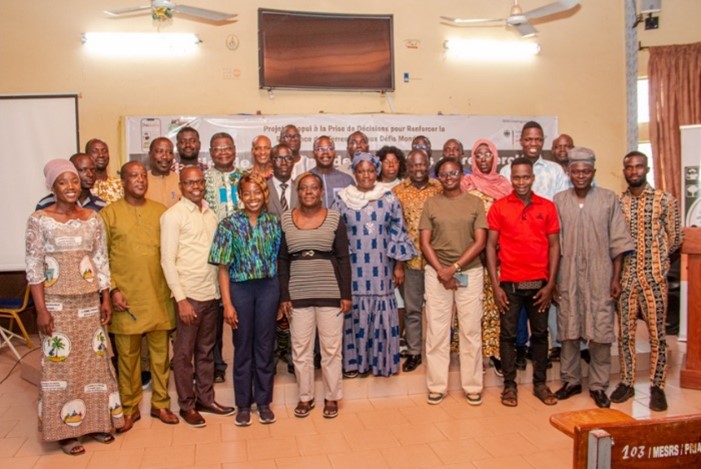
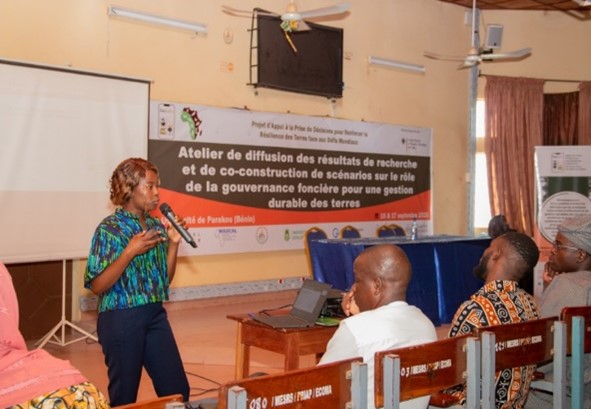
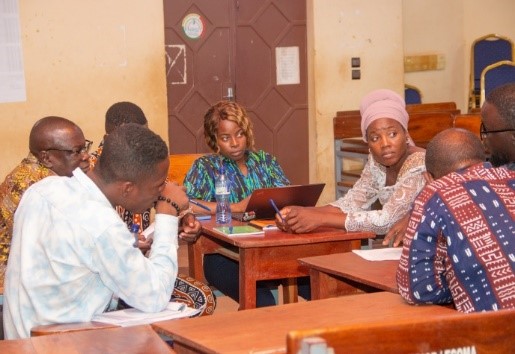
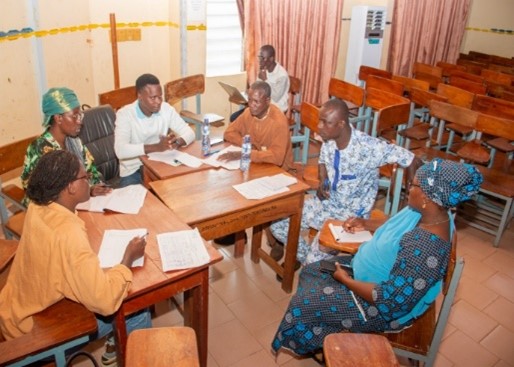
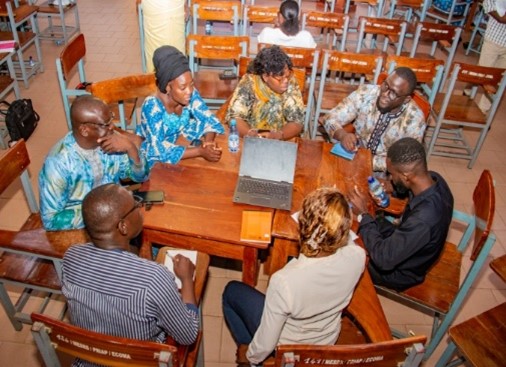
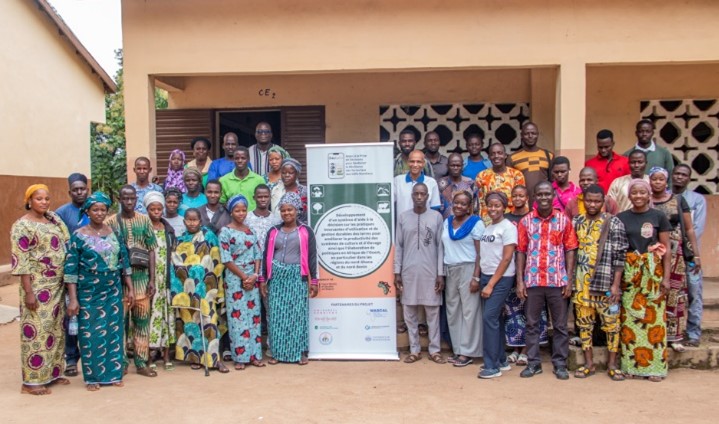
If Benin is to accelerate the adoption of sustainable land management (SLM) practices, strengthening tenure security is no longer optional. On 16 and 17 September 2025, WASCAL brought together 38 stakeholders, including researchers, farmers, traditional leaders, policymakers, practitioners and extension workers, under the DecLaRe (Decision Support for Strengthening Land Resilience in the Face of Global Challenges) project. The aim was to jointly rethink how land governance could unlock more SLM practices in northern Benin. The event comprised a two-day indoor workshop at the University of Parakou. The workshop combined dissemination of scientific results with participatory scenario building to improve understanding of the influence of land tenure security on agricultural decision-making.
SETTING THE SCENE: WHY LAND GOVERNANCE MATTERS FOR SLM
Northern Benin is characterized by agricultural expansion, demographic pressure, climate change, and a growing demand for arable land. In such a setting, secure land tenure is essential for farmers to invest in soil fertility management, agroforestry, composting, intercropping or fencing. However, land tenure security in rural Benin is not uniform. While customary systems remain dominant, new forms of ownership recognition have emerged, such as the Attestation de Détention Coutumière (ADC), offering households administrative recognition without replacing customary rights entirely. The research presented at the workshop in the context of northern Benin focused on investigations into how farmers as a group, migrants, women, men, and youth as sub-groups perceive these systems, and how these perceptions shape land-related decisions.
DISSEMINATION OF RESEARCH FINDINGS
During the two-day workshop, the first session was a presentation of the results of the mental model research conducted by a DecLaRe PhD fellow. Using the M-Tool, the study captured the perceived consequences of ADC and its socio-demographic variations in northern Benin. The study identified twelve drivers, categorized into three groups:
- Agriculture and environmental drivers: agricultural productivity, food security, environmental conservation
- Economy and infrastructure drivers: economic stability, access to credit, land investment, infrastructure development
- Social cohesion and equity dynamics: conflicts, women’s empowerment, cultural preservation, migration, land grabbing
The research was presented through visual maps illustrating the interactions between key drivers and customary land. This sparked curiosity and reflection. This was followed by a lively discussion in which participants validated the findings with insights from their own experience in the field, highlighting a shared view that land governance is complex and requires collective reasoning that goes beyond research alone.
VALIDATION OF RESEARCH FINDINGS THROUGH A WORLD CAFÉ
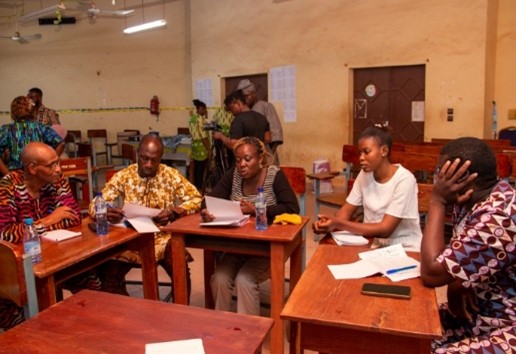
The key activity on the first day of the workshop involved stakeholders working in groups in a World Café format to validate and enrich the research findings. There were three café tables, each representing one group of drivers. Initially, each group was assigned to a specific café table. Afterwards, the groups rotated through three rounds, ensuring that by the end of the session, all participants had been engaged with each group of drivers.
Each table had a guidance sheet summarizing the drivers’ description and mechanisms of potential influence as evidenced by the research findings. During the discussions, one farmer pointed out that the issue of agricultural productivity cannot be addressed without acknowledging the fact that women have limited access to land. A municipal representative insisted that conflicts are not only about land scarcity but also about unclear inheritance rules and having only one name on the ADC. An extension worker noted that credit programmes often fail because they do not align with crop calendars or household cash cycles. By the end of the afternoon, the initial mental models had become richer and more grounded in real-world experience.
On the second day, the focus shifted towards refining and verifying five visual maps based on the mental models. To facilitate interactive discussions, the visual maps were printed and pinned to the walls of the workshop room. One map was aggregated and four were disaggregated by gender and migration status, respectively. Participants were asked to identify arrows on each map that needed to be reversed, added, strengthened or removed, from their own perspective. They were also asked to question arrows, confirm strong links, raise questions about others, and mark uncertainties.